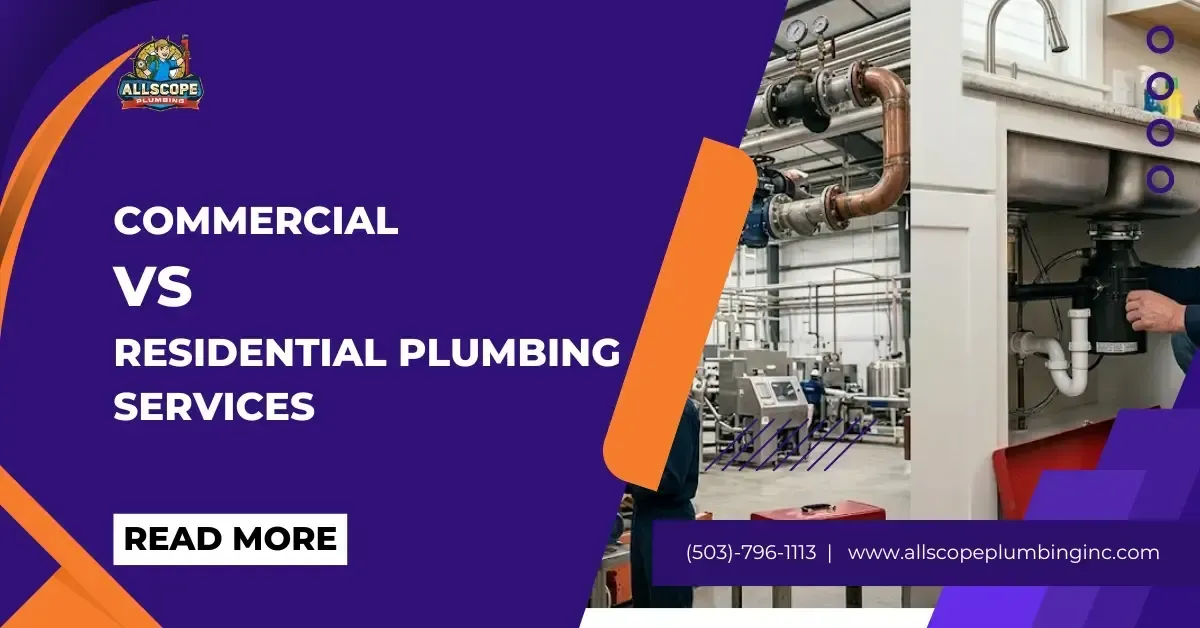
Commercial vs Residential Plumbing Services in Oregon: Key Differences Explained
If you own a building in Oregon, at some point, you'll need a plumber. The real question is: which type? Commercial vs residential plumbing services aren't just a label. It's the difference between hiring someone qualified for your property and hiring someone who could leave you out of compliance with Oregon code.
Whether you manage a restaurant in Portland or own a home in Bend, this guide breaks down exactly what separates the two, what each type of service covers, and how to choose the right plumber for your specific situation.
What Is Commercial Plumbing?
Commercial plumbing covers the water and drainage systems inside large-scale properties. Think office buildings, restaurants, hotels, schools, hospitals, and retail centers. These properties serve dozens or hundreds of people every day, and their plumbing systems are built to match that demand.
Scale and System Complexity
A commercial system handles far more daily water use than a home ever would. It relies on industrial-grade components:
High-capacity water heaters.
Pressurized multi-floor pipe networks.
Floor drains, grease traps.
Backflow prevention assemblies.
When one part fails in a commercial system, the impact hits your entire operation fast.
These systems often span multiple floors and require precise pressure balancing across each zone. That level of complexity needs a plumber with the right credentials and hands-on experience with large-scale infrastructure.
Types of Commercial Buildings Served in Oregon
Commercial plumbing work in Oregon covers a wide range of property types. In Portland, that includes mixed-use retail and apartment towers, breweries, and medical offices. In Salem and Eugene, it covers school districts, government buildings, and manufacturing facilities. In Bend and Medford, commercial plumbers work on hotels, restaurants, and growing tech campuses.
Each property type comes with its own demands. A hospital in Salem needs specialty water purification. A restaurant in Portland needs a grease management system. A multi-story office in Eugene needs zoned pressure management throughout the building.
Oregon Licensing Requirements for Commercial Plumbing Work
Oregon has its own rules, and they matter.
Under OAR 918-695, anyone performing commercial plumbing work in Oregon must hold an Oregon journeyman plumber license with verified commercial-level experience hours. On top of that, the contractor must carry an active CCB (Oregon Construction Contractors Board) license.
Commercial work also triggers permit and plan review requirements through the Oregon Building Codes Division. Before any work begins, those permits need to be filed and approved.
Hiring a plumber who skips this step doesn't just risk a failed inspection. It can trigger stop-work orders, fines, and legal liability for the property owner.
What Is Residential Plumbing?
Residential plumbing focuses on the water systems inside homes and smaller living spaces. This includes single-family houses, duplexes, townhomes, and small rental units. The systems are simpler, the fixtures are standard, and the daily usage is much lower than in a commercial setting.
Scope of Residential Systems
A typical home runs two basic systems. Clean water comes in through a supply line. Wastewater exits through a drain system. Most homes have one kitchen, one or two bathrooms, and hookups for appliances like dishwashers and washing machines. Everything is contained, and problems are usually easy to trace.
That simplicity works in your favor when something goes wrong. A skilled residential plumber can often diagnose and fix the issue in a single visit.
Common Residential Plumbing Services
Residential plumbing services cover the everyday repairs and upgrades homeowners need: fixing leaks, clearing clogged drains, replacing water heaters, installing toilets and faucets, and roughing in pipes during new home construction.
When a homebuilder in Bend is framing a new neighborhood, residential plumbing services for a new construction project are typically scoped and priced differently from standard repair work because of the volume and coordination involved.
Oregon Residential Plumbing Codes (OPSC)
Residential plumbing in Oregon is governed by the Oregon Plumbing Specialty Code (OPSC). This code sets the standards for pipe materials, fixture placement, drain slopes, venting, and water heater installation in homes.
Before any permitted work is finalized, an Oregon inspector will verify that everything meets OPSC requirements. Homeowners should always ask their plumber to confirm permit status before work starts.
Commercial vs. Residential Plumbing: Side-by-Side Comparison
Here's a quick look at the core differences between commercial plumbing and residential plumbing in Oregon. Use this table to find where your property fits.
7 Key Differences Between Commercial and Residential Plumbing in Oregon
Understanding these differences helps you hire the right professional for your property and avoid costly mistakes.
1. System Size and Water Demand
A restaurant in Portland can push thousands of gallons of water through its system in a single day. A family home in Medford might use a fraction of that in a week.
Commercial systems require larger supply lines, stronger water heaters, and pipe configurations that can handle constant peak demand. Residential systems are sized for moderate, predictable use patterns.
2. Oregon Code and Permit Requirements
Commercial projects in Oregon require a formal permit application, plan review, and multiple inspections through the Oregon Building Codes Division. For most residential plumbing repairs, permits are simpler or not required at all, depending on the scope of work.
Getting the permit tier wrong creates real problems. Work done without proper commercial permits won't pass inspection and could void your property insurance.
3. Fixture Durability and Specifications
A commercial restroom in a Salem office building sees hundreds of uses per day. The fixtures installed there need to hold up to that kind of demand. Commercial-grade toilets, faucets, and drains are built to different durability specs than what you'd find at a hardware store.
Residential fixtures work fine in a home. Put them in a commercial setting and they'll fail quickly and create maintenance headaches.
When comparing decisions like urinal installation vs toilet installation for a commercial restroom, the fixture type, water usage rating, and OPSC compliance all factor into what gets approved during inspection.
4. Project Timelines and Scheduling
A home water heater replacement might take a few hours. A commercial plumbing retrofit in a multi-story building in Eugene can run for weeks. Commercial projects require coordination between the plumber, general contractor, property manager, building inspector, and sometimes the local utility. Scheduling windows are tighter, and delays cost real money when a business can't operate.
5. Licensing and Certification Differences in Oregon
Under OAR 918-695, Oregon requires commercial plumbers to document verified hours working on commercial systems before they can receive full commercial licensure. A plumber holding only a residential Oregon journeyman plumber license is not qualified to perform commercial work under state law.
Hiring the wrong person for a commercial job doesn't just mean subpar work. It creates direct liability for you as the property owner.
6. Maintenance Needs and Service Agreements
Commercial plumbing systems need scheduled maintenance to stay compliant with the Oregon Health Authority and local code. Grease traps require regular cleaning. Backflow prevention assemblies need annual testing and certification.
Water heaters in high-use environments should be serviced frequently. Residential plumbing systems are mostly maintained on a reactive basis: you call when something breaks.
Commercial property owners in Portland, Eugene, and Salem often carry maintenance contracts with their plumbing provider to keep inspections on schedule and systems running without interruption.
7. Cost Structure and Pricing
Several factors affect the cost of plumbing services, and the distinction between commercial and residential is one of the biggest. Residential plumbing service calls in Oregon typically run between $150 and $800, depending on the complexity. Commercial plumbing service calls start around $500 and scale significantly from there based on system size, permit requirements, labor tier, and parts.
Commercial maintenance contracts in Oregon are priced annually and can range from a few thousand dollars for a small restaurant to well over $20,000 for a large multi-tenant building. The investment is worth it. Unplanned downtime in a commercial property costs far more than a scheduled maintenance visit.
Ready to talk about your property? Call Allscope Plumbing and Construction at (503)-796-1113 for a free estimate. We serve Portland, Eugene, Bend, Salem, and Medford.
How to Know Which Type of Plumber You Need in Oregon
This is the question most Oregon property owners are really asking. Use the breakdowns below to find your answer fast.
You Need a Commercial Plumber If...
Your property is zoned commercial or mixed-use
Your building serves members of the public daily
You have multiple restrooms, kitchens, or breakrooms
Your building is three or more stories
Your project requires permits through the Oregon Building Codes Division
You need compliance with Oregon Health Authority standards
Your system includes a grease trap, backflow preventer, or medical gas line
You Need a Residential Plumber If...
You own a single-family home, duplex, or small rental property
Your repair involves standard household fixtures
You need a water heater replaced or a drain cleared
Your home is going through new construction with a residential builder
The work falls clearly under the OPSC residential provisions
What About Mixed-Use Buildings and Multi-Family Properties?
This question comes up constantly for property owners in Portland, where ground-floor retail and upper-floor apartments are everywhere in neighborhoods like the Pearl District and Division Street. The answer isn't always simple, but here's the rule of thumb.
In Oregon, properties with three or more dwelling units typically fall under commercial plumbing jurisdiction. That means the system must meet commercial code standards, and the plumber must hold the appropriate license. Mixed-use buildings always require commercial expertise, because both the building type and the occupancy class trigger commercial code review.
If you're unsure where your building falls, don't guess. A licensed Oregon plumber can review your property type and give you a clear answer before any work begins.
Own a mixed-use or multi-family property in Portland or Eugene? Call (503)-796-1113 and we'll help you figure out exactly what you need.
Frequently Asked Questions
What's the difference between commercial and residential plumbing?
Commercial plumbing handles large-scale systems in businesses, schools, and public buildings. Residential plumbing covers home systems, including single-family houses and small rentals. The differences include system size, fixture grade, licensing requirements, permit processes, and cost. In Oregon, commercial work must comply with OAR 918-695 and requires a separately qualified plumber.
Do I need a special license for commercial plumbing in Oregon?
Yes. Under Oregon law, commercial plumbing work requires an Oregon journeyman plumber license with verified commercial experience hours, plus an active CCB license. Residential licensure alone does not qualify a plumber to legally work on commercial systems. Always ask your plumber for their license number and verify it through the Oregon CCB before work begins.
Can a residential plumber work on a commercial building in Oregon?
Legally, no. A plumber holding only a residential Oregon journeyman plumber license cannot perform permitted commercial plumbing work under OAR 918-695. If work is done without proper commercial credentials, it will likely fail inspection. That failure becomes the property owner's problem in the form of fines, stop-work orders, and potential liability.
How much does commercial plumbing cost compared to residential in Oregon?
Residential plumbing service calls in Oregon typically run $150 to $800. Commercial plumbing service costs start around $500 and can reach $5,000 or more depending on system complexity, permit requirements, and labor scope. Annual commercial maintenance contracts vary widely based on property size and service scope. For a more specific estimate, contact Allscope Plumbing and Construction at (503)-796-1113.
What type of plumber do I need for an apartment building in Oregon?
In Oregon, apartment buildings with three or more units fall under commercial plumbing jurisdiction. That means you need a plumber licensed for commercial work under OAR 918-695, not just a standard residential plumbing contractor. If you're unsure about your building's classification, a quick call to a licensed Oregon plumber can save you from a costly permit mistake.
Serving Oregon with Commercial and Residential Plumbing Services
Don't wait until a plumbing problem shuts down your business or floods your home. Call Allscope Plumbing and Construction today at (503)-796-1113 for a free estimate.
We'll send the right licensed plumber to your property, get your permits filed, and get the work done right the first time.
